How David Popa Painted Massive Portraits on Alberta’s Wildest Winter Landscapes

Reading time: 10 minutes

Discover how artist David Popa created extremely realistic portraits among Abraham Lake’s ice bubbles and how you can visit this wild part of Alberta.

  • Popa used charcoal and chalk to create his large-scale portraits.
  • Abraham Lake’s unique ice bubbles appear each winter and shift with the weather.
  • You can stay and explore the wild Nordegg area where Popa made his ephemeral art.
See related articles

“I really didn’t anticipate that it would be this beautiful.” That’s the impression artist David Popa was left with after spending nearly 2 weeks immersed in the wild and wintry landscapes near Nordegg, Alberta.

Popa is an American artist based in Finland. He creates massive and realistic portraits in otherworldly locations using natural materials. Each piece is painstakingly created with charcoal and chalk, plus water sourced from nearby. They’re all ephemeral, lasting for days or mere hours before dissolving back into the elements.

His earthly canvases have included ice floats and islets in Finland, the island of Crete in Greece, a desert in Saudia Arabia, rocky terrain in Utah, a French vineyard, and Norwegian islands. And now, Abraham Lake and Cline River Canyon in Alberta's David Thompson Country are the latest addition to his works.

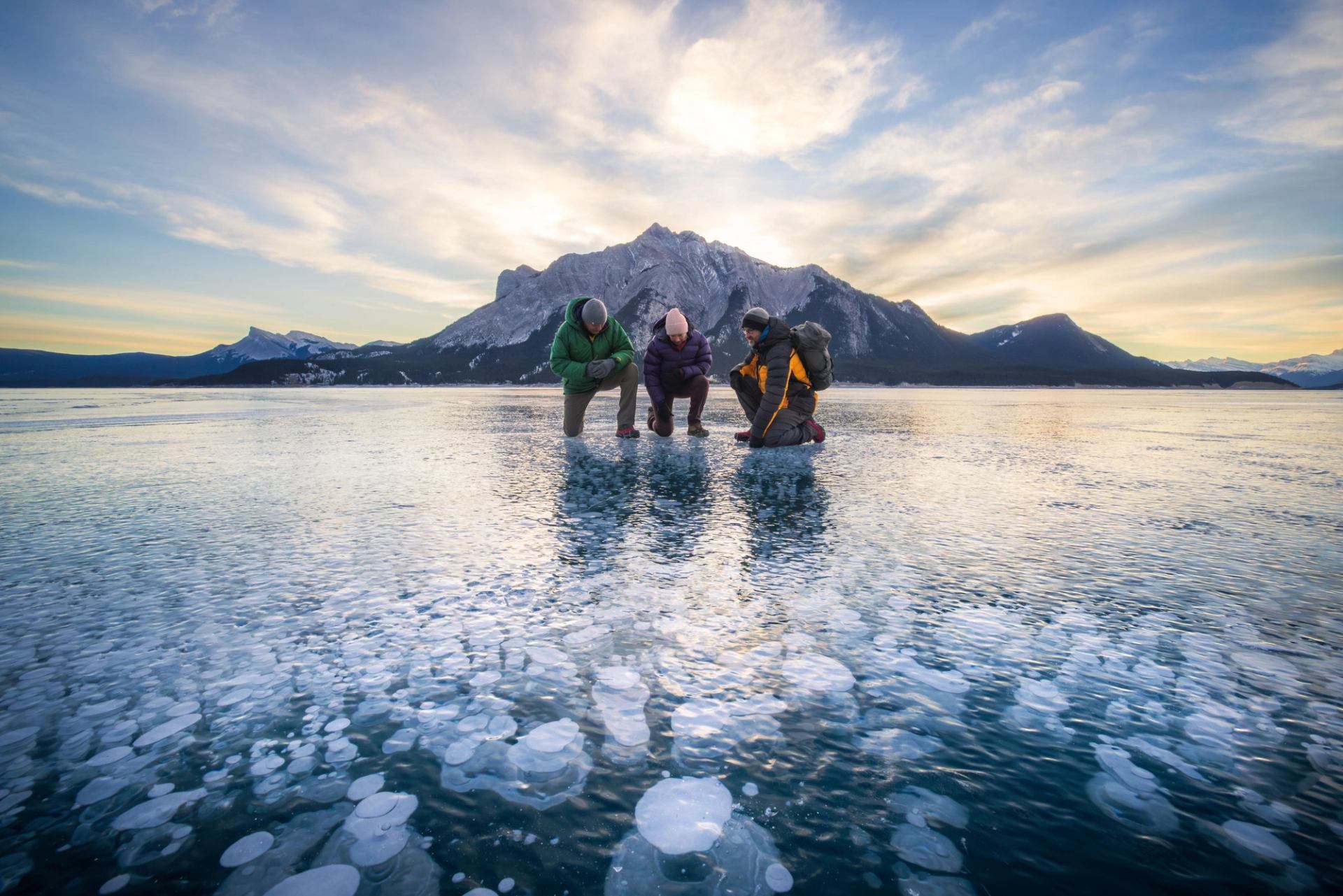
The warm Chinook winds blowing across Abraham Lake create fluid and fascinating ice formations, which gave artist David Popa plenty of texture to consider in his art.

In Alberta this winter, Popa found “one of the most beautiful canvases that I’ve experienced” at Abraham Lake near the mountain hamlet of Nordegg. With its undeniably photogenic frozen bubbles, Abraham Lake has gained fame in recent years. The towers of frosty bubbles trapped beneath the ice morph throughout winter, creating a canvas as ephemeral as Popa’s art.

Visitors have started to catch onto the fantastical nature of the lake’s bubbles. Popa though, gained a more intimate appreciation for the area after spending hours creating art on its surface.

“It gave us absolutely everything from deep cold temperatures to really warm, cracking ice, beautiful deep turquoise, the bubbles are amazing, to even the windswept snow,” he says.

Creating art on some of Alberta’s wildest landscapes

Popa embraced the unpredictability of an Alberta winter when creating his artwork in the Nordegg area, which is about equal distance (about 3 to 4 hours’ drive depending on the route and conditions) from big cities Calgary and Edmonton.

He faced blasting wind gusts, sub-zero workdays, “insane ice breakages” from swinging temperatures and sunny Chinook days that melted his charcoal into unexpected new shades.

Popa’s ambitious portrait on Abraham Lake was created with the expert safety advice of a local guide from Canadian Rockies Escapes.

The huge canvas of Abraham Lake made for some tricky decisions for Popa. The human-made lake stretches for about 35 km (21.7 mi) and is 1–⁠2 km (1.6–⁠3.2 mi) wide. But he knew the lake would be perfect for one of his portraits.

“To do a work in collaboration with those methane bubbles and just this unbelievable depth of colour of Abraham Lake, is just incredible,” he says.

Popa worked closely with Brett Pawlyk, co-owner and head guide for local adventure tourism company Canadian Rockies Escapes, to find the perfect place on the ice for the artwork.

Pawlyk and his guides are on Abraham Lake almost daily assessing conditions and scoping out the most picturesque spots for tours. They post regular ice condition updates on Instagram and on their website.

How the Abraham Lake ice bubbles are created

“It is a very dynamic place,” Pawlyk says of Abraham Lake. “With the temperature swings, you get different formations in the ice. So, when it's minus 30, you get all kinds of cracks and fractures everywhere that create these beautiful mosaics, and then when it warms up, that expansion and contraction of the ice changes its character as well.”

The phenomenon of the ice bubbles at Abraham Lake happens because of a few very particular ingredients, Pawlyk explains.

First, the glacier-fed lake’s water level drops every spring, baring the lake’s bottom and allowing flowers and other vegetation to grow. As the water levels rise with winter meltwaters, the plants die and decompose, releasing bubbles of methane upwards.

When fall arrives and the surface begins to freeze, the methane continues to bubble up. But now the bubbles get trapped beneath the freezing surface. Bubbles continue to release from the lake floor, freezing in stacks.

While visitors can access Abraham Lake at Ice Bubbles Viewpoint (which has a parking lot), those who choose to visit with a local guide can more deeply understand the phenomenon and the Nordegg area.

Meanwhile up above, dry winds blow across the surface of Abraham Lake. These often-warm gusts have already dropped most of their remaining snow on the glaciers of the Columbia Icefield. For the lake, that means much less snow falls on the surface. The bit of snow that does land is blown away, shining the surface like sandpaper to reveal a glossy surface and bubbles below.

With his expert knowledge of Abraham Lake’s latest bubbles and fissures, Pawlyk recommended a prime spot a short ways away from the Ice Bubbles Viewpoint for Popa’s first portrait.

The serenity of Popa's more than 24-metre (80-foot) portrait on Abraham Lake doesn’t reveal how much the artist had to do to adapt to the shifting elements.

Portrait 1: Abraham Lake

Popa’s first Alberta portrait features a female figure partway in the Abraham Lake ice, in a moment of new life, he says. It signifies healing and rejuvenation, popular themes in Popa’s work.

Starting his piece on a warm and breezy winter day, Popa had to adapt on the fly to unexpected conditions.

“We were hovering around 0 to 3 degrees (Celsius; 32 to 37 degrees Fahrenheit), the first day I started, and the sun would heat up the charcoal... basically changing the shades from light to dark. So, it was extremely hard to judge exactly what it was I was doing,” he says.

He persisted, painting stroke by stroke with sprayer bottles filled with lake water and charcoal, checking his progress constantly through his drone camera.

Finally, when daylight was lost, he and his production crew, which included Pawlyk and Alberta videographers and photographers, packed up. In a stroke of luck, it was a rare windless night in Nordegg, and Popa was able to continue to work on the piece the next day. 

And the final result? It floored him.

“By the time we got to the final hour of sunlight, it was just an absolute magical moment where we got to see it in three different main lighting stages,” he says. 

“The first was sunset, where it caught this sort of shimmering, almost silvery tone from the charcoal... And then when the sun set, the ice changed from this kind of lighter turquoise, this deep, deep green blue, which was just absolutely stunning. And then finally, the fireworks really set off when the sunset happened and these pinks and oranges and everything just absolutely lit up the lake and I was freaking out.”

Portrait 2: Cline River Canyon

During some pie and coffee at Miners’ Cafe in Nordegg, Popa and his local Alberta crew planned the location for his next piece: a canyon with frozen walls well-loved by ice climbers.

As soon as he saw wintry Cline River Canyon for himself, Popa knew this was the spot for his next portrait.

A charcoal portrait of a woman’s face is painted in the snow and ice beside a creek in Cline River Canyon.
In Popa's second piece, the female figure’s hair flows directly into the trickling canyon waters.

“It was an entirely other feeling,” he says, “it was like entering an ice cathedral, but so calm and peaceful in that canyon. And the colours were unbelievable. To see the river flowing through. And that vivid turquoise yet again, right next to these iron ochre, orange rocks and stones, with these smoothed over, like, frosty white ice with snow. The combination was unlike I'd ever seen.”

That winter wilderness view Popa describes is accessible year-round via a trail that follows the canyon rim, but the canyon floor that served as his canvas is not. (Canadian Rockies Escapes brings guests to the trail by hike or snowshoe throughout the winter). To access the interior of the canyon itself, Popa took the opportunity to rappel in with local ice climbing experts Girth Hitch Guiding, the first time the adventurous artist had ever commuted to work that way.

On the canyon floor, Popa’s second portrait flowed seamlessly into the natural bends of the river through the canyon. “As I was working right along in the canyon, to hear the trickling of the river, it just was, you know, no pun intended, I entered into a deep flow state.”

Popa’s work is meant to be seen from above. Painted on the canyon floor, this portrait was unique among all his work because he could see it from the top of the canyon through his own eyes—during sunset no less—rather than through his drone. “And that was just pure magic,” he says.

A helicopter tour of the Nordegg area and Abraham Lake gave David Popa an exceptional view of and another way to scope out potential locations for his artwork.

Portraits 3 & 4: Abraham Lake

Soaring over alpine lakes and canyons isn’t just for drones, of course. Popa took a helicopter tour and guided snowshoe hike with Rockies Heli Canada and Canadian Rockies Escapes. And while Popa thought he’d identified his next stretch of canvas from the skies, he was ultimately drawn back to Abraham Lake, which had provided another miraculous weather opportunity.

On this particular day, the conditions at a spot a ways away from the Ice Bubbles Viewpoint were unusually calm. Plus, the ice had practically formed itself into Popa’s perfect artscape. Recent warm daytime weather and cold nights had made fascinating formations in the ice.

“It was one of the most insane ice breakages, amazing cracks and amazing separation, which is stuff that I look for,” Popa says. "That texture, and those different ice flows, that split apart and then refreeze."

Get inspiration for your own trip to Nordegg, Alberta

Days of warm winter weather followed by colder temperatures at Abraham Lake caused shattering cracks to form and re-freeze. The shifting landscape made for exciting terrain for Popa.

Popa chose a particularly dramatic fissure to be central to his work. As he sketched it out over night, he decided he would place a male and female figure on either side of the refrozen chasm. In his words, though they’re cracked and divided, “the healing is happening and there is a reconciliation happening.”

For the crack between portraits, he was inspired by Japanese kintsugi. The centuries-old technique uses gold to repair shattered ceramics, creating something newly precious.

Serendipitously, Popa met a Nordegg painter, Crystalynn Tarr of Rendered Earth, just days earlier who makes natural pigments similar to his. “I noticed on her shelf, this beautiful gold-ochre pigment, and quite a good amount of it.”

The night before he was to start the cracked portraits, he called Pawlyk of Canadian Rockies Escapes, who called Tarr to see if it would be possible to acquire some of her earth pigment. They hustled to Tarr’s art studio in the basement of a local church in the middle of the night.

“We go outside and the northern lights are out and literally streaming right over and pointing to the church as if it was just fate and destiny that I would create that work and get that yellow earth pigment,” Popa says. (Nordegg’s lack of light pollution makes for excellent stargazing and aurora-hunting.)

The next day, it was –15 degrees Celsius (5 degrees Fahrenheit)—a fairly typical winter forecast in the Canadian Rockies, but intense conditions for a full day of painting outdoors.

Popa painted nonstop for a full day to complete this massive double portrait on the ice at Abraham Lake. The artist is standing in thie image. Can you spot him?

With more wind and snow forecast for that night, the portraits needed to be completed before the sun had fully set. Popa worked nonstop throughout the day, his local team working like a NASCAR pit crew changing out his pigment-sprayers, keeping them from freezing and hastily handing him bites of food to eat on the go.

“I painted like I never painted before. I did not stop at all,” he says. “We just got into this crazy flow state to create this extremely unique work.”

By sunset, the portraits were nearly complete. Tarr joined him on the ice to add the final touch of golden earth pigment with him.

“It was just an absolutely incredible experience,” he says. “I just felt like I created everything I would have wanted to create in one of the most beautiful places I've ever been with some of the most beautiful people.”

Popa predicts that this part of Alberta is bound to continue to attract visitors with a sense of adventure. “The area of Nordegg, I feel like, has something so special,” he says. “And it feels special to be in a spot that I know, in the next five to 10 years, will just continue to expand. It's really a jewel in that area.”